

ESP32-S3 PRO Development Board – ESP32-S3-WROOM-1 N16R8, 16MB Flash, 8MB PSRAM & MicroSD Support
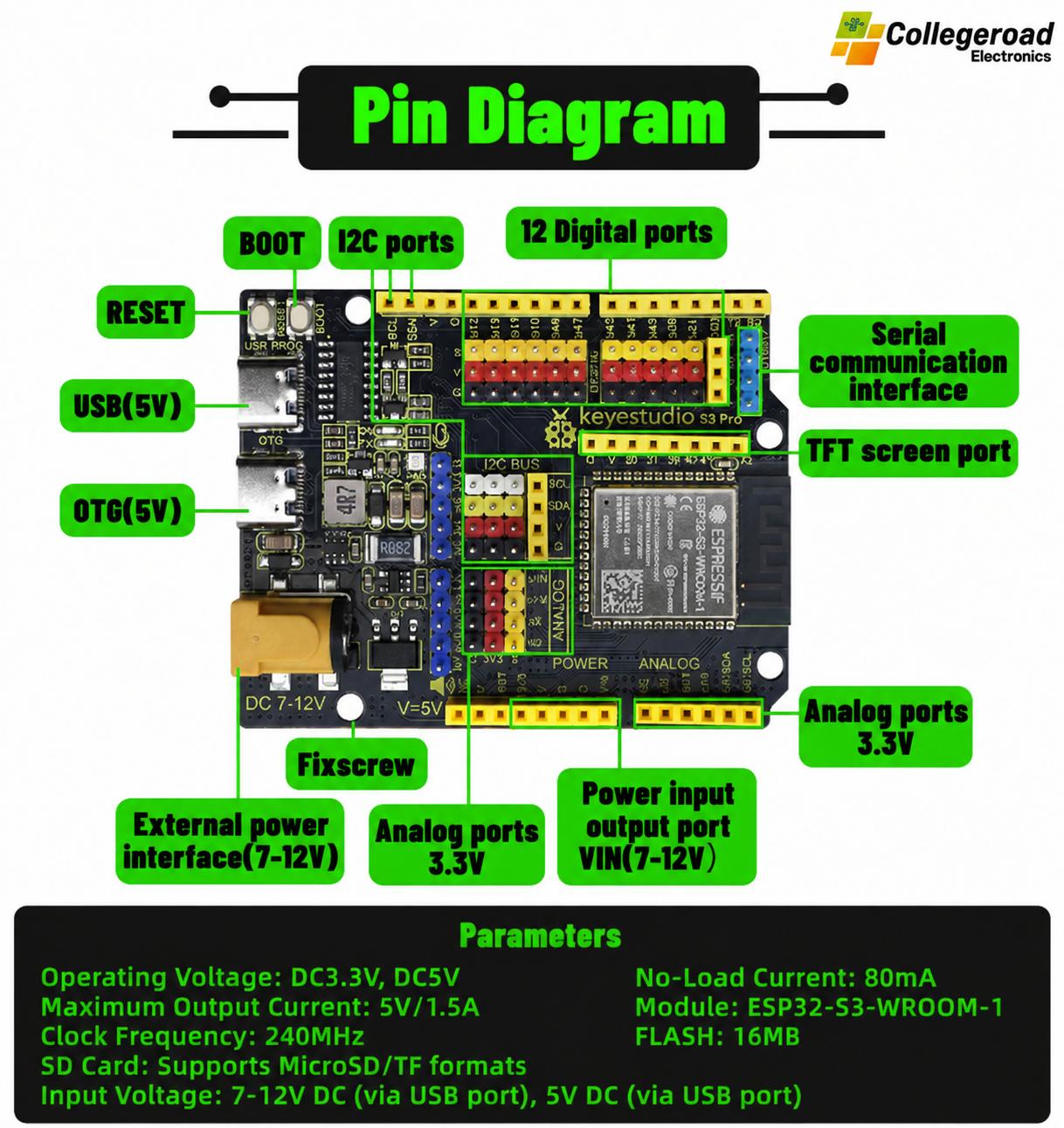
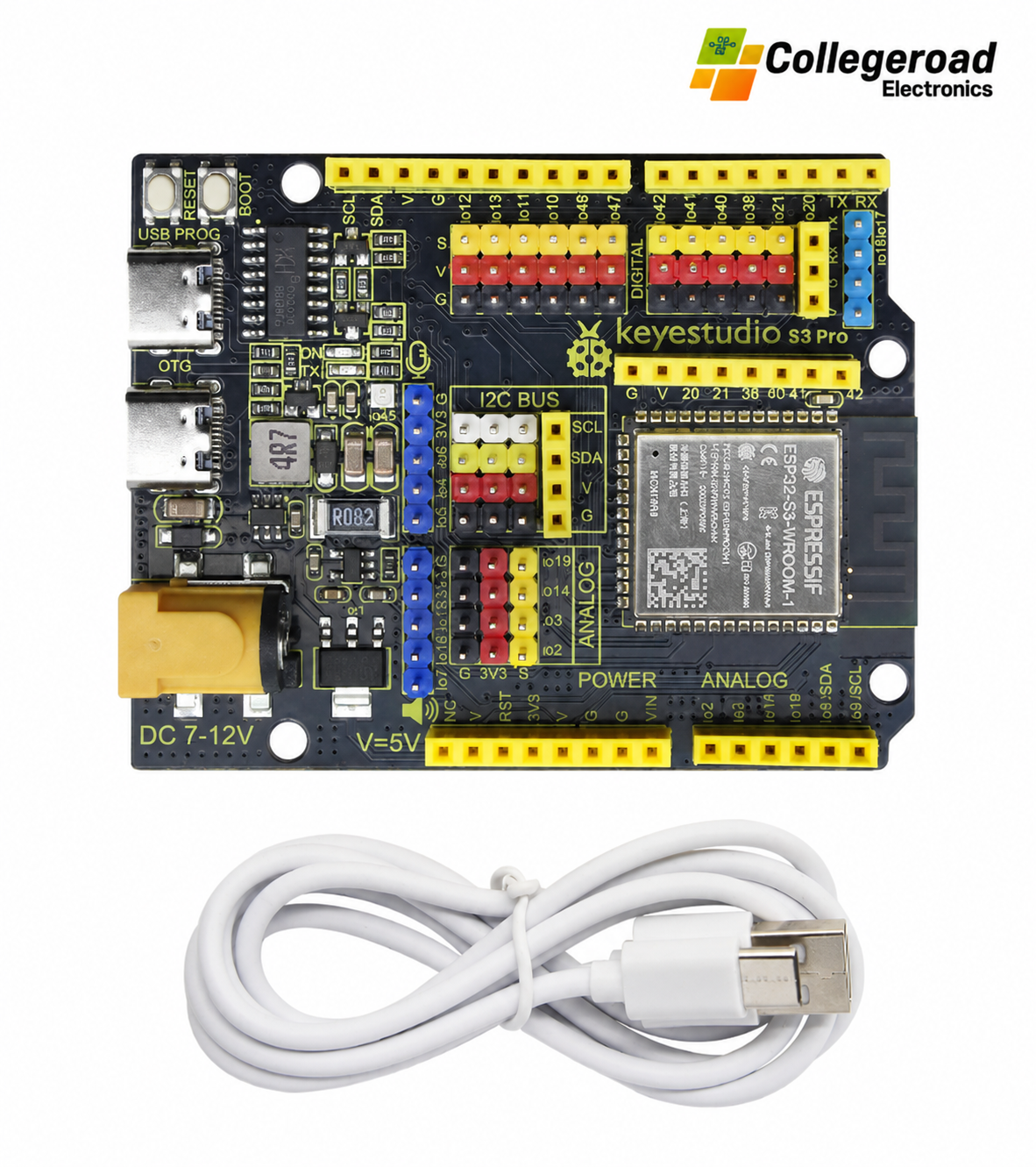
The ESP32-S3 PRO Development Board is a high-performance embedded development platform built around the ESP32-S3-WROOM-1 N16R8 module. It combines powerful processing, Wi-Fi and Bluetooth LE connectivity with expanded interfaces for prototyping, IoT, automation, data acquisition, and embedded control applications.
Compared with conventional ESP32-S3 development boards, the PRO version provides additional features such as on-board current monitoring, MicroSD/TF card support, enhanced power regulation, and easy access to most GPIO pins through header connectors. This makes it particularly useful for projects requiring external sensors, displays, communication modules, motors, or other peripherals.
The integrated DC-DC converter and LDO regulators provide a stable power supply for the ESP32-S3 and connected modules, reducing the need for additional external power circuitry.
Key Features
- Based on the powerful ESP32-S3-WROOM-1 N16R8 module
- Dual-core 32-bit processor with clock frequency up to 240 MHz
- 16 MB Flash memory
- 8 MB PSRAM
- Integrated 2.4 GHz Wi-Fi
- Integrated Bluetooth Low Energy (BLE)
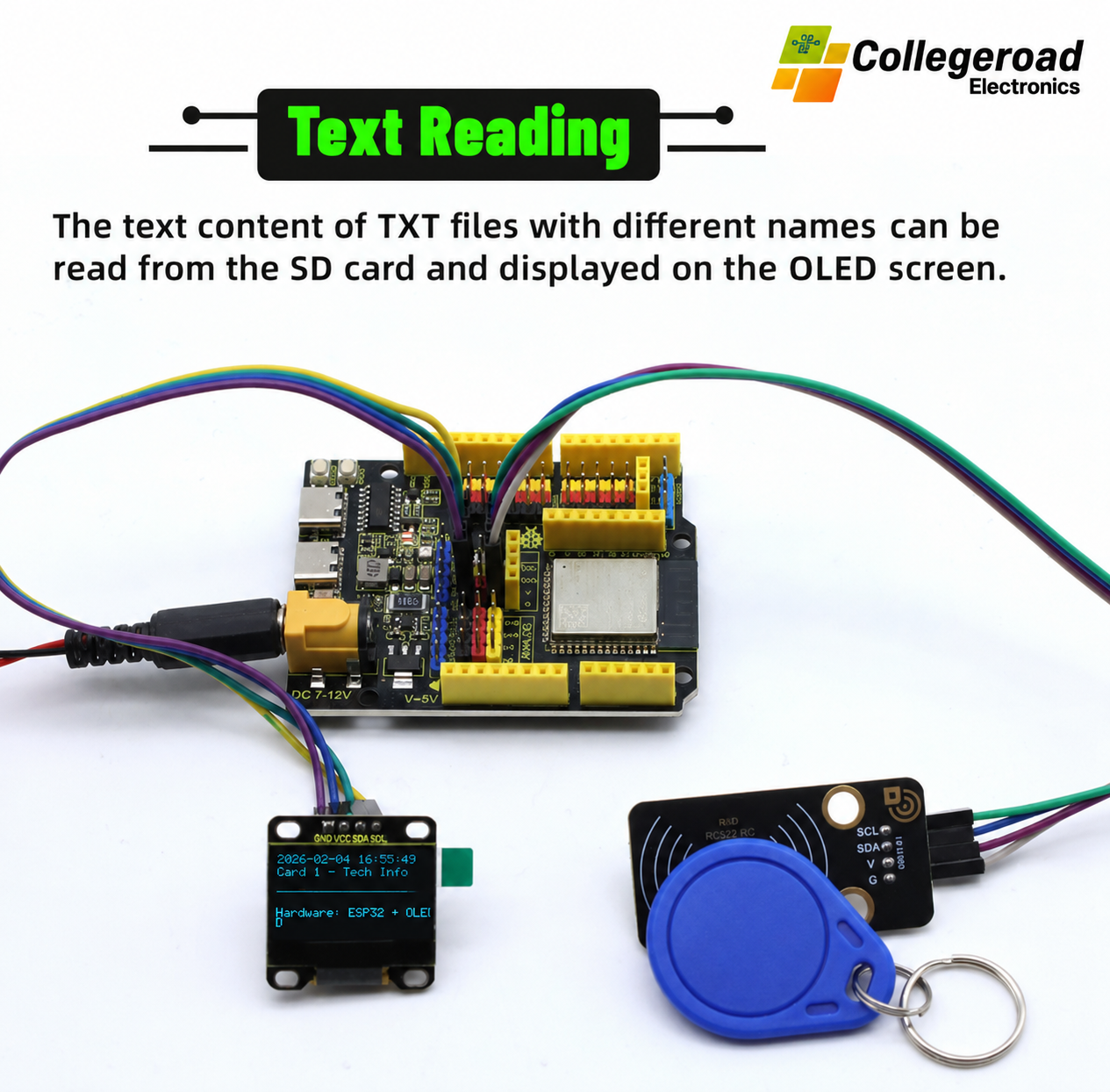
- Built-in MicroSD/TF card interface
- On-board current-sensing functionality
- Most ESP32-S3 GPIO pins available through pin headers
- Integrated DC-DC and LDO power regulation
- Supports both 3.3 V and 5 V peripherals
- Suitable for sensor expansion and external modules
- USB connectivity for programming, debugging, communication, and power
- Suitable for Arduino IDE, ESP-IDF and PlatformIO development
- Compact development platform for advanced embedded applications
Technical Specifications
| Parameter | Specification |
|---|---|
| Main Module | ESP32-S3-WROOM-1 |
| Memory Configuration | N16R8 |
| Flash Memory | 16 MB |
| PSRAM | 8 MB |
| Maximum CPU Frequency | 240 MHz |
| Logic Voltage | 3.3 V |
| Peripheral Power | 3.3 V / 5 V |
| USB Supply | 5 V DC |
| External Input Supply | Typically 7–12 V DC through the appropriate external power input |
| No-Load Current | Approx. 80 mA |
| Maximum Output Current | Up to 1.5 A |
| Wireless Connectivity | 2.4 GHz Wi-Fi |
| Bluetooth | Bluetooth Low Energy |
| Storage | MicroSD / TF card support |
| Current Monitoring | On-board current sensing |
| GPIO Expansion | Most available pins routed to headers |
| Power Regulation | On-board DC-DC converter and LDO |
| Board Dimensions | Approx. 69 × 54 mm |
Power note: A USB port normally uses a 5 V supply. If the board supports a 7–12 V input, this should be connected through its dedicated VIN/DC power input rather than applying 7–12 V directly to a standard USB connection.
ESP32-S3 Processing Capability
The ESP32-S3 is designed for applications requiring significantly more processing capability than basic microcontrollers. Its dual-core architecture and large external memory configuration make this board suitable for applications involving:
- Graphical user interfaces
- Image and signal processing
- Sensor data processing
- Network-connected devices
- Data logging
- Embedded web servers
- Machine-learning and edge-AI experiments
- Real-time monitoring and control
The N16R8 configuration provides 16 MB of Flash and 8 MB of PSRAM, allowing larger firmware, graphics resources, buffers, web interfaces, and application data to be handled more comfortably.
Wi-Fi and Bluetooth LE
Integrated wireless connectivity enables the board to communicate directly with smartphones, computers, routers, gateways, and IoT platforms.
Typical wireless applications include:
- Wi-Fi sensor nodes
- MQTT devices
- Smart-home controllers
- Web-based control panels
- BLE peripherals
- BLE scanners
- Wireless data acquisition
- Remote equipment monitoring
- IoT gateways
The ESP32 2.8 Inch Capacitive Touch Display Development Board is a feature-rich embedded platform designed for developers building interactive IoT and HMI applications. It integrates a 2.8-inch TFT LCD with capacitive touch, allowing users to create modern graphical user interfaces without additional display hardware.
MicroSD / TF Card Support
The integrated storage interface allows a MicroSD card to be used for applications requiring additional removable storage.
It can be used for:
- Sensor data logging
- Measurement records
- Configuration files
- Images and graphics
- Audio files
- CSV data
- Web interface resources
- Firmware-related files
- Long-term experimental data storage
Current Sensing
One of the useful additions of the ESP32-S3 PRO board is its current-monitoring capability. This can help developers observe the power consumption of the system during development and evaluate how different peripherals or operating modes affect current consumption.
This feature is particularly useful for:
- Battery-powered projects
- Low-power IoT development
- Power optimization
- Embedded-system testing
- Comparing active and sleep-mode consumption
GPIO and Expansion
Most available ESP32-S3 pins are brought out to convenient headers, allowing the board to connect with a wide range of external modules and sensors.
Depending on the selected GPIO pins and firmware configuration, peripherals may communicate using interfaces such as:
- GPIO
- ADC
- PWM
- UART
- SPI
- I²C
- I²S
- USB
This makes the board suitable as a central controller for complex embedded prototypes.
Applications
The ESP32-S3 PRO can be used for:
- IoT development
- Smart-home automation
- Industrial monitoring
- Sensor networks
- Environmental monitoring
- Data acquisition systems
- Wireless control systems
- Robotics
- Embedded HMI systems
- MicroSD data loggers
- BLE applications
- Wi-Fi monitoring devices
- Portable electronic instruments
- Automation controllers
- Educational electronics projects
- Embedded web servers
- Edge-AI and TinyML experiments
- Prototype product development
Development Support
The board can generally be programmed using popular ESP32 development environments including:
Arduino IDE, ESP-IDF, PlatformIO, MicroPython and other ESP32-S3 compatible development frameworks.


 No products in the cart.
Reviews
There are no reviews yet.