
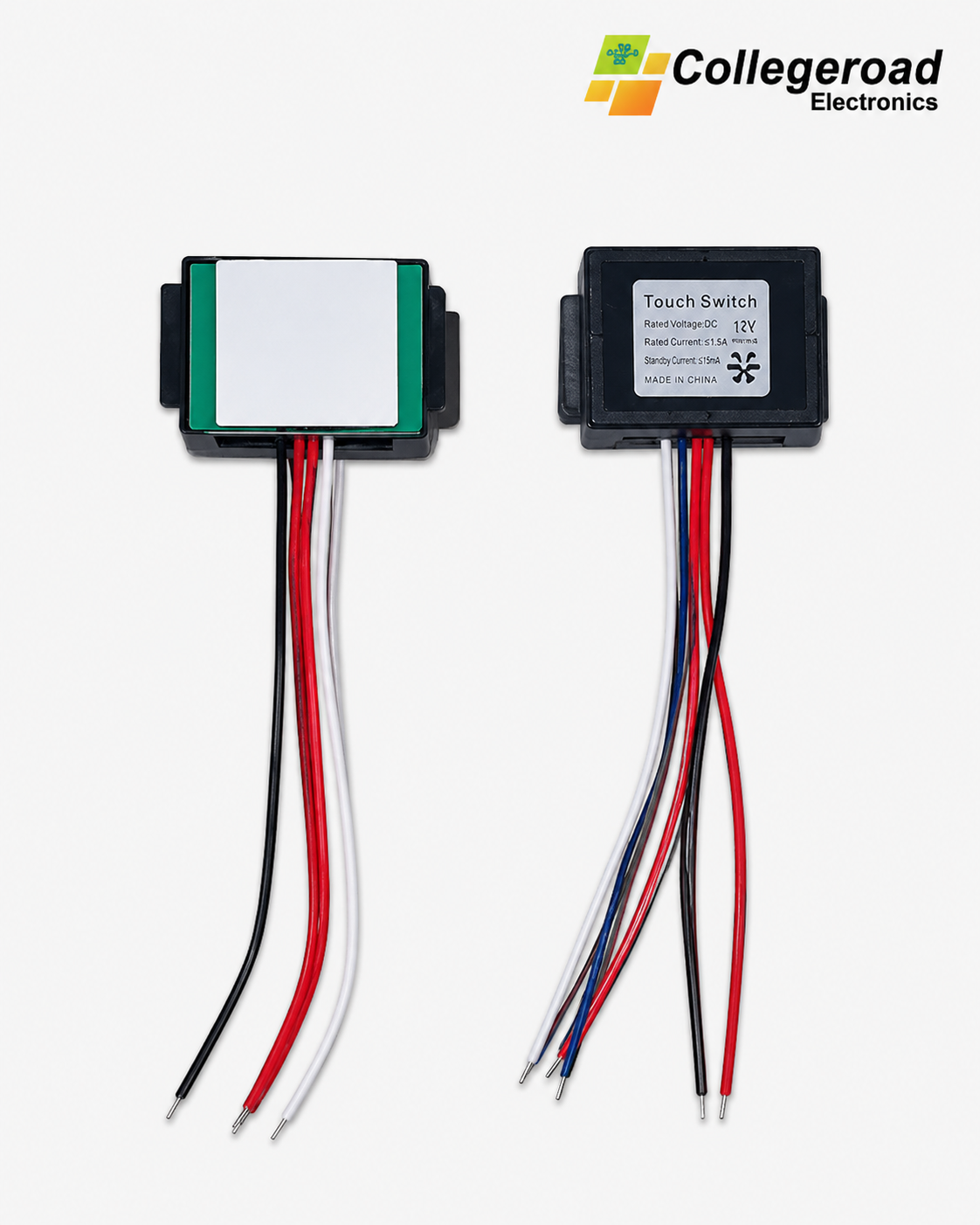

TTP224 Mirror Touch Sensor – Capacitive Touch Switch for Glass & Smart Mirrors
The TTP224 Mirror Touch Sensor is a capacitive touch-control solution designed to replace conventional mechanical switches with a modern, touch-sensitive interface. Based on the TTP224 capacitive touch detector IC, it detects changes in capacitance when a finger approaches or touches the sensing area. The TTP224 family supports up to four independent touch channels, making it suitable for single-button as well as multi-function control panels.
A major advantage of capacitive sensing is that the touch element can be positioned behind a suitable non-conductive surface, allowing the control to remain hidden while the user operates it from the front. This makes the sensor especially useful for smart mirrors, glass control panels, furniture, lighting controls, appliances, and decorative electronic installations. The TTP224 documentation specifically supports capacitive interfaces through non-conductive dielectric materials.
Key Features
- Capacitive Touch Detection – Detects a finger through changes in capacitance without requiring a conventional mechanical push button.
- Touch Through Non-Conductive Surfaces – Can be integrated behind suitable glass, plastic and other dielectric materials, depending on thickness and installation conditions.
- Up to 4 Touch Channels – The TTP224 IC can independently process four capacitive touch pads with separate outputs.
- Wide Operating Voltage – The TTP224/TTP224N operates from approximately 2.4 V to 5.5 V DC, making it suitable for common embedded electronics and microcontroller systems.
- Low Power Consumption – Typical current consumption at 3 V is approximately 2.5 µA in low-power mode and 9 µA in fast mode, without output load.
- Fast Touch Response – The standard TTP224 provides an approximate response time of 100 ms in fast mode and 200 ms in low-power mode at 3 V.
- Adjustable Sensitivity – Touch sensitivity can be adjusted using external capacitance in the approximately 0–50 pF range for each touch pad.
- Automatic Calibration – The IC automatically recalibrates during operation; the datasheet specifies a recalibration period of approximately 4 seconds when no key is being touched.
- Multiple Output Modes – Supports options including direct or toggle operation, active-high or active-low output, and CMOS or open-drain output, depending on circuit configuration.
- Low-Power and Fast Modes – Operating mode can be selected according to the required response speed and power consumption.
- No Mechanical Wear – Because operation is based on capacitive sensing rather than a moving mechanical contact, it is useful for applications requiring a clean and modern user interface.
Typical Specifications
Sensor Type: Capacitive Touch Sensor
Controller IC: TTP224 / compatible TTP224-family device
Touch Channels: Up to 4 independent channels
Operating Voltage: 2.4–5.5 V DC
Typical Current at 3 V: 2.5 µA low-power mode / 9 µA fast mode
Typical Response Time: 100 ms fast mode / 200 ms low-power mode for TTP224
Sensitivity Adjustment: External capacitance, approximately 0–50 pF
Output Options: Direct / Toggle
Output Polarity: Active High / Active Low selectable by configuration
Output Type: CMOS / Open Drain selectable by configuration
Calibration: Automatic recalibration
Interface: Digital touch output
Technology: Capacitive sensing
Note: Exact PCB size, connector arrangement, channel configuration and output wiring can vary between different TTP224 mirror-sensor modules. A commonly available four-channel TTP224 development module, for example, measures approximately 35 × 29 mm, but this dimension should not be assumed for every mirror-touch version.
How It Works
The sensor continuously monitors the capacitance of its touch electrode. When a finger approaches the sensing area, the additional capacitance changes the measured value. The TTP224 detects this change and switches the corresponding digital output.
For mirror installations, the sensing electrode can be positioned behind a suitable non-conductive portion of the glass so that users can operate the function simply by touching the front surface. Installation and sensitivity should be tested for the actual glass thickness and construction. Conductive or metallic layers near the sensing electrode can affect capacitive sensing; the TTP224 datasheet specifically warns against conductive material in the panel covering the sensing PCB.
Applications
The TTP224 Mirror Touch Sensor is suitable for:
- Smart Mirrors
- Bathroom Mirror Lighting
- LED Mirror ON/OFF Controls
- Touch-Controlled Vanity Mirrors
- Glass Touch Panels
- LED Lighting Systems
- Furniture Lighting
- Home Automation
- Smart Home Control Panels
- Touch-Sensitive Wall Panels
- Kitchen Appliances
- Consumer Electronics
- Decorative Lighting
- Display Cabinets
- Embedded Electronic Projects
- Arduino and Microcontroller Projects
- DIY Electronic Control Systems
- Mechanical Push-Button Replacement
Smart Mirror Applications
The sensor is particularly useful for building modern LED smart mirrors. A touch area can be incorporated into the front of the mirror to control functions such as:
Light ON/OFF • LED illumination • brightness control logic • defogger control • auxiliary lighting • smart-mirror functions
Multiple functions can also be implemented when several TTP224 channels are used with a microcontroller or suitable control circuitry.
Microcontroller Integration
The TTP224 provides digital outputs, allowing it to interface with embedded controllers such as Arduino, ESP32, ESP8266, Raspberry Pi GPIO systems, STM32, PIC and other microcontrollers. A controller can monitor the touch output and use it to operate relays, LEDs, MOSFET drivers, smart-home functions or other electronic circuits. TTP224 modules are specifically designed to provide straightforward digital touch outputs for external projects.
Why Choose a TTP224 Mirror Touch Sensor?
The TTP224 provides a practical combination of touch sensitivity, low power consumption, configurable output behavior, automatic calibration and easy digital interfacing. It is an excellent solution for replacing traditional switches with a clean, modern and discreet touch interface, particularly in smart mirrors, lighting products, home automation and custom electronic control panels.


 No products in the cart.
Reviews
There are no reviews yet.